
Friday, April 15, 2022

“So while they may have been far from perfect, the ancient Greeks seem to have developed the art of seeing life, the world and themselves with greater candor and unclouded clarity that is managed by most civilizations, including perhaps our own.”
Mythos by, Stephen Fry is a comprehensive and entertaining retelling of the Ancient Greek myths. Fry manages to retell these myths in a modern style, without diluting them. This is a great collection for those who are new to Greek mythology and don’t quite know where to start. Fry does such fantastic job setting up the foundation for these myths and organizing them in such a way that is not confusing or overwhelming. This is also engaging enough for those who are familiar with these stories and want to revisit them.
What I like about what Fry does in Mythos, is how he breaks down how much Ancient Greek (and Roman) is used in our everyday lives, especially in the western world. He particularly explains the origins of many of our words (my linguistics people, you’ll appreciate this book).
“First came Apate, Deceit, whom the Romans called Fraud (from whom we derive the words ‘fraud,’ ‘fraudulent,’ and ‘fraudster’).”
Also check this excerpt out from the mythological story explaining the origins of medicine.
“Enraged, Apollo asked his sister Artemis to take revenge. Only too willingly, she attacked the palace at Phlegyantis with plague arrows - poisoned darts that spread a terrible disease throughout the compound. Many besides Coronis were infected.”
Coronis sounds a whole lot like … 😅
What I particularly found most interesting about these myths is how many of them mirror Biblical stories, and one could argue that they are telling some of these stories from another prospective. I think Theologians and historians could have a field day with this. Here are some parallels I drew:
One could claim that Zeus and Lucifer are actually the same being. Lucifer fell from heaven “like lightening” in the Bible after being kicked out of heaven by God and thus Earth became his dominion. In the Greek myth, Zeus won his battle against the Titans and “assumed overall command are supreme leader and emperor, lord of the firmament, master of weather and storms: King of the Gods, Sky Father, Cloud-Gatherer. Thunder and lightning were his to command.”
The creation of man also have some similarities - being made out of clay by Prometheus, the breath of Zeus and some essence from Athena (there’s a trinity here…) and one doesn’t have to read far in the book of Genesis to see the parallels.
There’s a flood story and Fry has a footnote about how historians have been able to prove that a massive flood did occur and this particular mythological story lines up with the story of Noah.
We’ve got a story about wine being turned into better wine (Jesus turning water into wine at a wedding as the display of his first miracle) and a story about an elderly couple being given the opportunity to flee their hometown because it was beyond saving (the story of Lot and his wife).
This is the most interesting to me: how the book of Enoch (which has been taken out of most Bibles, but some do include, and it’s possible to obtain it on it own) talks about creatures called the Nephilim. These are half demon, half human hybrids. The angels that were kicked out of heaven with Lucifer/Satan found humans attractive and procreated with them.There were so many hybrids running around rampant and polluting the human bloodline that God was like “Um no. Let me get a flood going and wipe out this nonsense.” Many of the Greek gods had tangs (yes, tangs) going on with humans and there is even a hybrid called Nephele. Centaurs are a common creature that represents this union of divine/spiritual/animalic beings and humans. As Fry writes “The unnameable and savage progeny of this unnatural union between man and horse were named, after him [Centauros], centaurs.”
The mini theology lesson aside, why read ancient myths? What do these stories reveal about human nature and how many often perceive the divine? And why do so many civilizations and cultures have similar stories during times in which they had almost no contact with each other?
Aside, from ancient societies using myth to describe the way things come into existence, we have this desire to explain the world around us, whether we have a faith/religion we believe in or not and when elements of the world around us can no longer be explained through tangible means, we tend to dig deeper and embrace the spiritual. There is a deeper yearning within the soul to lean on something greater than ourselves in trying times. This is why we often see people turning to faith in larger numbers during times of crisis.
To me myths, whether they are Greek, Norse, Celtic, etc. etc. reveal so much about human nature and I find them so interesting. Mythos is a worthwhile, intelligent and entertaining read. It’s also FUNNY! What you do or do not believe is irrelevant here, this is just good fun. And for those of you who are interested in the deeper questions of theology, you’re still in for a good treat. I also think this is a fantastic companion read for Edith Hamilton’s The Greek Way; combine these two and you’ve got a great introduction to the Ancient Greeks, for those who need an entry point and didn’t know where to start. I look forward to reading Heros and Troy this year by Fry, and I will also accompany them with the audiobooks because Fry narrates them himself and he’s such a joy to listen to.
Rating: 4/5.
Like my bookish content? Follow me on Instagram for more and SUBSCRIBE to my YouTube channel!
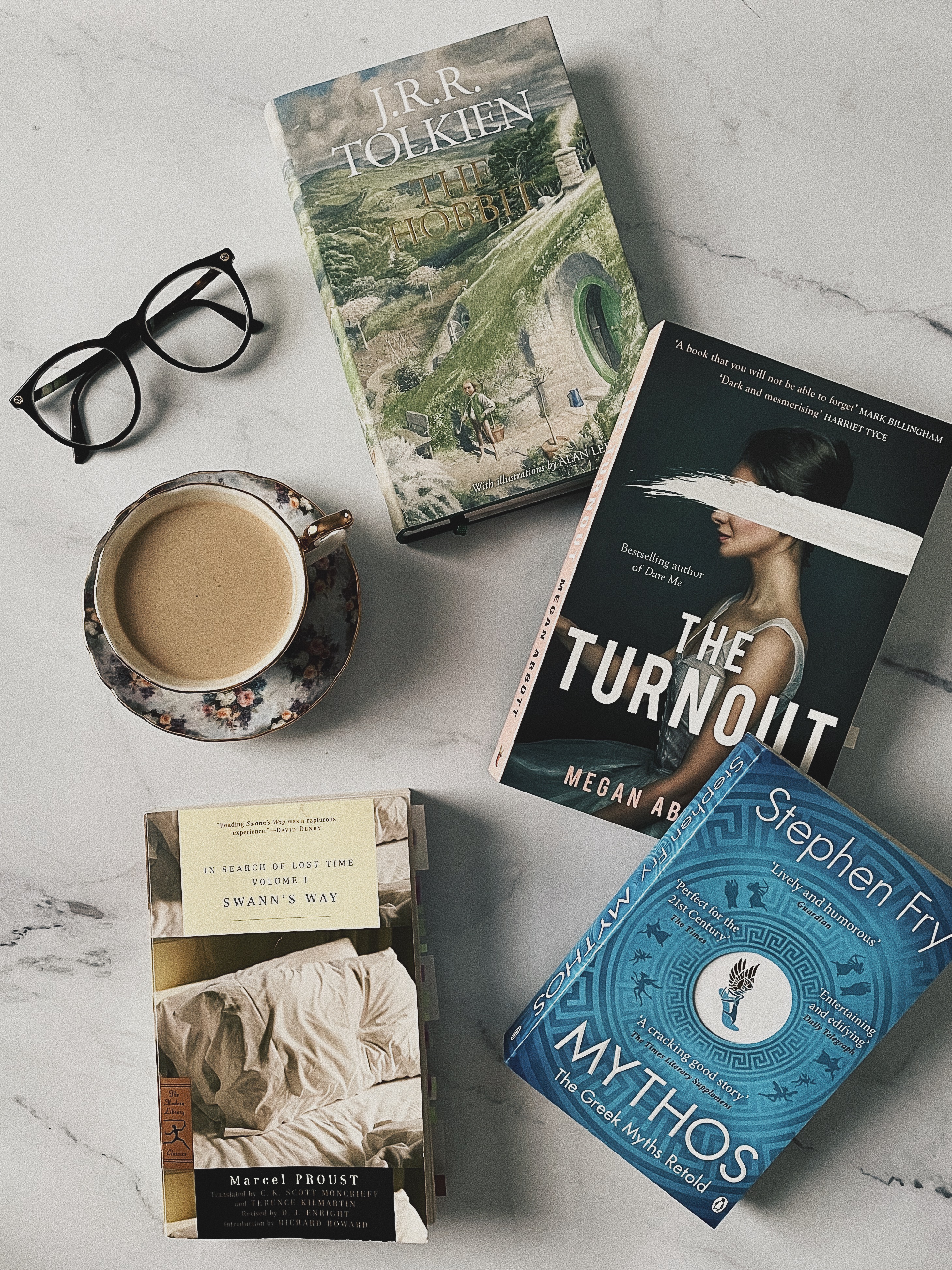
Friday, March 25, 2022
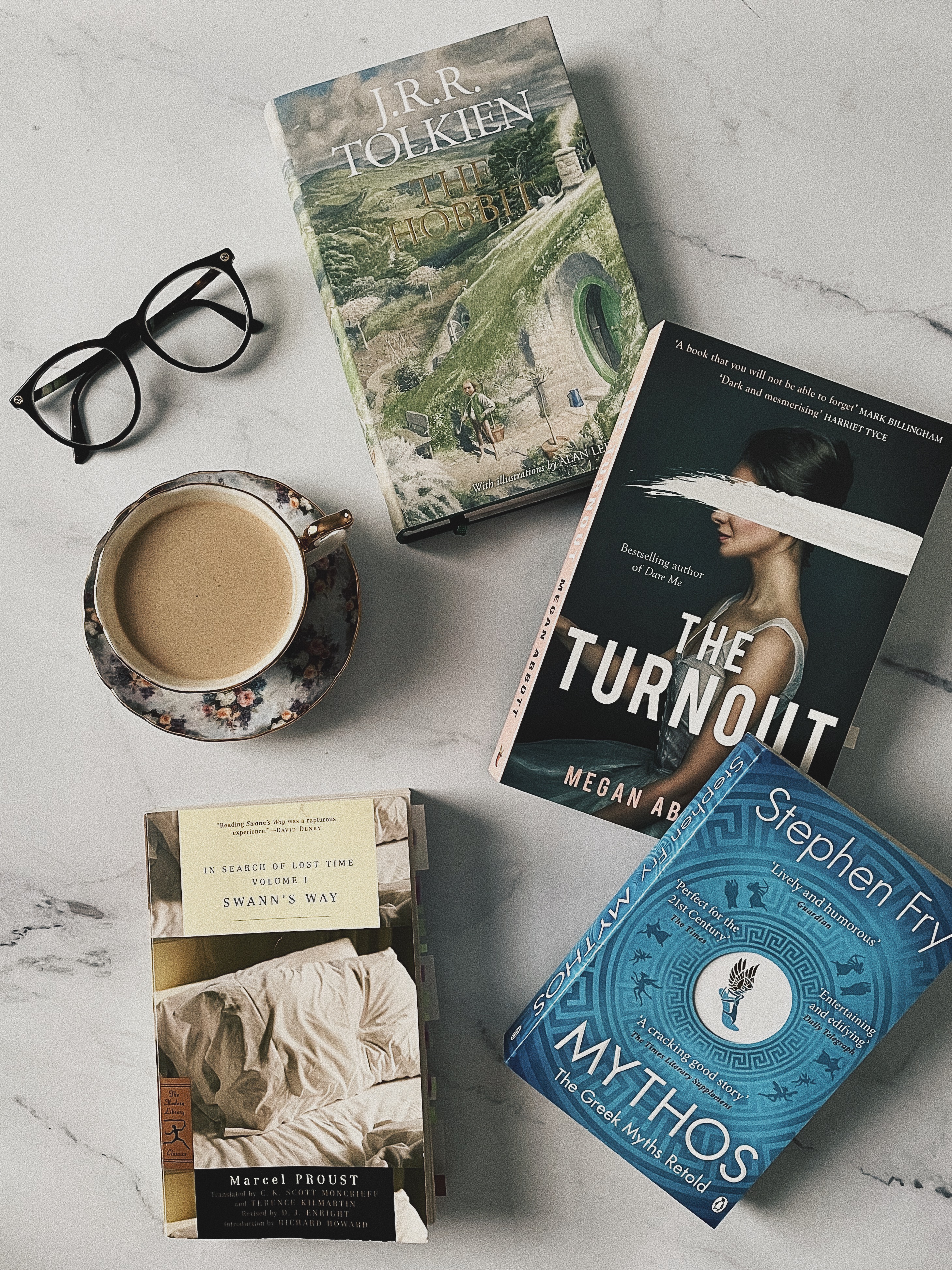
I know a lot of people feel like January and February drag on, but I love these two cold, dreary months. For me, they are the last sigh of winter before spring starts creeping in.
This month, I’ve got some books on my reading list that I’m really excited about.
- Swann’s Way - I started this in January. Wow. What can I say about what this so far? It’s ethereal. A friend described it best and she said to me, “It’s like reading a dream.” I’m surprised by how quickly I’m reading this, even though I find myself rereading multiple passages because they are so beautifully written. It’s easy for me to sink into this and it’s hard for me to put down.
- The Turnout - I’m eager to see how I get on with the ballet themed psychological thriller. I was also able to get a head start on this at the end of January. No opinions yet.
- Mythos - I love Greek mythology and I also love listening to Stephen Fry speak. This man could explain to me how grass grows and I’d listen. I’m going to accompany this book with the audiobook because it’s narrated by Fry.
- The Hobbit - As much as I love Lord of the Rings, I’ve never read The Hobbit … I’m going to correct this error once I finish Swann’s Way.
What are you reading this month?
Like my bookish content? Follow me on Instagram for more and SUBSCRIBE to my YouTube channel!

Monday, June 14, 2021

Do you gravitate towards retellings of classics? I have a difficult time resisting, even though I’ve been let down by some of them. I think its ambitious and difficult to take a beloved classic and then put a spin on the original - but I applaud authors who go for it because I think it take guts.
Some authors will take the classic and retell it in simpler language, make it more comedic or add more context, which is what Stephen Fry has done with Mthyos, Heroes and Troy. I recently got my hands on these three and can’t wait to read them. There are so many Ancient Greek Mythology retellings, that it’s a bit overwhelming. I especially can’t seem to resist them! It’s no secret I’m fascinated by the Ancient Greeks and their mythology is so entertaining and nuanced that retellings of the same myths over and over again, never seem to get old. I also have Edith Hamilton’s Mythology and in her book she includes Norse Mythology (I also haven’t read this one yet, because… so many books and so little time). I’ve resisted Circe since it was published, but it’s constantly in the back of my mind, so I ordered it. Circe is a novel in which it seems that people either love it to hate it, which makes it even more appealing to me. I’m also particular curious about the Miller’s style - people have described it as “dry,” and a bit “sparse.” This makes me chuckle because I have a hunch she did this on purpose - this is exactly how the style of Ancient Greek literature is described.
Retellings are challenging because they are reimagining works that are greatly loved. Often, the reader is seeking to experience how the original made them feel - they are seeking nostalgia. Retellings often focus on characters or narratives that may have been secondary in the original text, or tell the story from the perspective of another major character, whose point of view the reader did not get. How many times have authors retold Pride & Prejudice from Mr. Darcy’s perspective?
Disappointment often occurs with retellings because the reader states the author “Got is wrong!” “Misinterpreted the text!” “The original author would have NEVER done this!?” I have personally said all of these things, however I don’t think this is a bad thing - you know how the saying goes, “No two people ever read the same book.” In a way, when an author decides to retell a well-know story, it’s their interpretation and that doesn’t mean that their interpretation is wrong. I read an interpretation of Pride & Prejudice that I really did not like, but again, it’s a work of fiction and the author can do whatever they like - I don’t have to like it and what didn’t work for me, may work for someone else and vice versa.
Either way, I enjoy retellings because they force me to think about the original text from a new perspective, regardless of if I end up liking it or not, it’s always fun to engage with a classic narrative in a fresh way. It also reminds me not to always take reading so seriously - just sit back, enjoy the story and relax. When I want the original, I can always have a reread.
Like my bookish content? Follow me on Instagram for more!

Social Media
Search